A company has no fingers: An executive introduction to European Business Wallets
Europe is giving every business a verifiable digital identity, and it is not a personal wallet made bigger. The European Business Wallet (EBW) lets a company prove who it is, who may act for it, and what it has said or signed, to any counterpart in the EU, with legal effect. This introduction explains what the EBW is, how it differs from the EUDI Wallet for citizens, and how it fits alongside the e-invoicing and e-delivery networks businesses already rely on.
Europe is giving every business a verifiable digital identity, and it is not a personal wallet made bigger. The European Business Wallet (EBW) lets a company prove who it is, who may act for it, and what it has said or signed, to any counterpart in the EU, with legal effect. This introduction explains what the EBW is, how it differs from the EUDI Wallet for citizens, and how it fits alongside the e-invoicing and e-delivery networks businesses already rely on.
Proving who you are, over and over
A growing company spends a surprising share of its admin effort proving three things by hand: who it is, who may act for it, and what it did.
Take Vellmark Industrial Supplies, a fictional Swedish company based in Stockholm, with 180 employees and customers in six countries. This year it opens a branch in Germany.
- Who the company is. The German business register wants a certified extract from Bolagsverket, the Swedish Companies Registration Office. A new bank, a key customer’s supplier portal and a public tender then ask for the same details again, each in its own format.
- Who may act for it. The new branch manager may sign contracts but not move money, yet nobody outside the company can check that. When a customer gets a request to change Vellmark’s bank details, it cannot tell genuine from fraud, so it picks up the phone.
- What it did. Engineers’ purchase receipts are retyped into accounting weeks later. Notices from Skatteverket, the Swedish Tax Agency, and from Bolagsverket arrive through different channels, and nobody can easily prove afterwards what was sent, received or shown.
On top of that, much routine work runs as scheduled jobs overnight. Any check that needs a person to approve it on a phone simply does not fit.
The European Business Wallet is designed to answer all three questions once, in a form any counterpart in the EU can verify.
Two wallets, two jobs
The EUDI Wallet is for people; the European Business Wallet is for legal persons, and EU law now treats them as separate instruments.
| EUDI Wallet | European Business Wallet | |
|---|---|---|
| Who owns it | A citizen or resident | A company, sole trader or public body |
| Anchor identity | Person identification data from a Member State | Organisation identity (EBWOID) from a business register such as Bolagsverket, using the EUID |
| Who uses it | One person, on their own device | Many employees, systems and scheduled jobs |
| Typical role | Holder | Issuer, holder and verifier, often on the same day |
| Record keeping | The person may delete their history | Sealed evidence kept for audits years later |
| Legal basis | eIDAS 2 (Regulation (EU) 2024/1183) | Proposed Business Wallet Regulation, COM(2025) 838 |
The amended eIDAS originally obliged Member States to provide wallets to natural and legal persons alike. The Business Wallet proposal narrows that obligation to natural persons and gives companies their own instrument. The two still work together: an employee uses their EUDI Wallet to authenticate, and the company’s European Business Wallet holds the mandate that says what that employee may do.
Go deeper: Business Wallets: Enabling Trust and Scale in the EUDI Wallet Ecosystem and The EUDI Wallet (eIDAS 2.0): A Business Guide to Use Cases.
A company has no fingers
Personal wallets assume one person, one phone and one thumb approving each presentation. A company has none of these, which changes the design in five ways.
- Roles change by the hour. In the morning Vellmark verifies a new buyer, at noon it presents its own credentials, and in the afternoon it issues a delivery confirmation. Role is a property of each transaction, not of the product.
- Many people, many mandates. One wallet serves many employees. Each power, such as approving a payment or signing a tender, is its own attestation, so one can be revoked without touching the others.
- Machines act for the company. Issuing credentials into a wallet can already run unattended. Presenting them machine to machine, under policies the owner sets and can revoke, is what businesses need next.
- Identity comes from registers. A person’s identity comes from a Member State. A company exists because of an entry in a business register, such as Bolagsverket in Sweden, so its wallet identity is anchored there.
- Evidence must outlive the moment. An auditor or tax authority may ask in 2033 what Vellmark proved in 2026. A business wallet keeps sealed, long-term verifiable records; a personal wallet lets its owner delete them.
The lesson from the EWC and WE BUILD Large Scale Pilots is simple: reuse the protocols and trust infrastructure of the EUDI Wallet, but not its assumptions.
Watch: a business register issuing a company’s identity into its wallet, in EBWOID issuance to Business Wallets with Bolagsverket. For builders: the European Business Wallet Owner ID workflow.
What the European Business Wallet provides
The proposal gives every business one legally recognised toolkit for identifying, authorising, signing and communicating across the EU.
- Organisation identity (EBWOID): who the company is, issued from its business register (in Sweden, Bolagsverket) and bound to its wallet.
- Attestations of attributes: VAT status, licences, certificates, bank account details, issued by the authority or institution that is the source of truth.
- Mandates and delegation: who may act for the company, and for what, revocable one at a time.
- Qualified signatures, seals and timestamps: legal equivalence to paper, recognised in every Member State.
- A secure communication channel: qualified electronic registered delivery (QERDS), giving proof of sending and receipt with legal effect.
- The European Digital Directory: a trusted source for finding and addressing other wallet owners, using the EUID where available.
- Trusted lists: a published list of European Business Wallet providers, so any counterpart can check that a wallet is genuine.
Public sector bodies must accept European Business Wallets. For businesses, adoption stays voluntary, so it has to be earned by making everyday work simpler.
Go deeper: Executive summary: European Business Wallet Regulation (2025) and how verification works in Trust and trust lists.
Where it fits in the systems you already use
A European Business Wallet does not replace the systems a company already runs. It proves the parties behind the documents and payments those systems exchange.
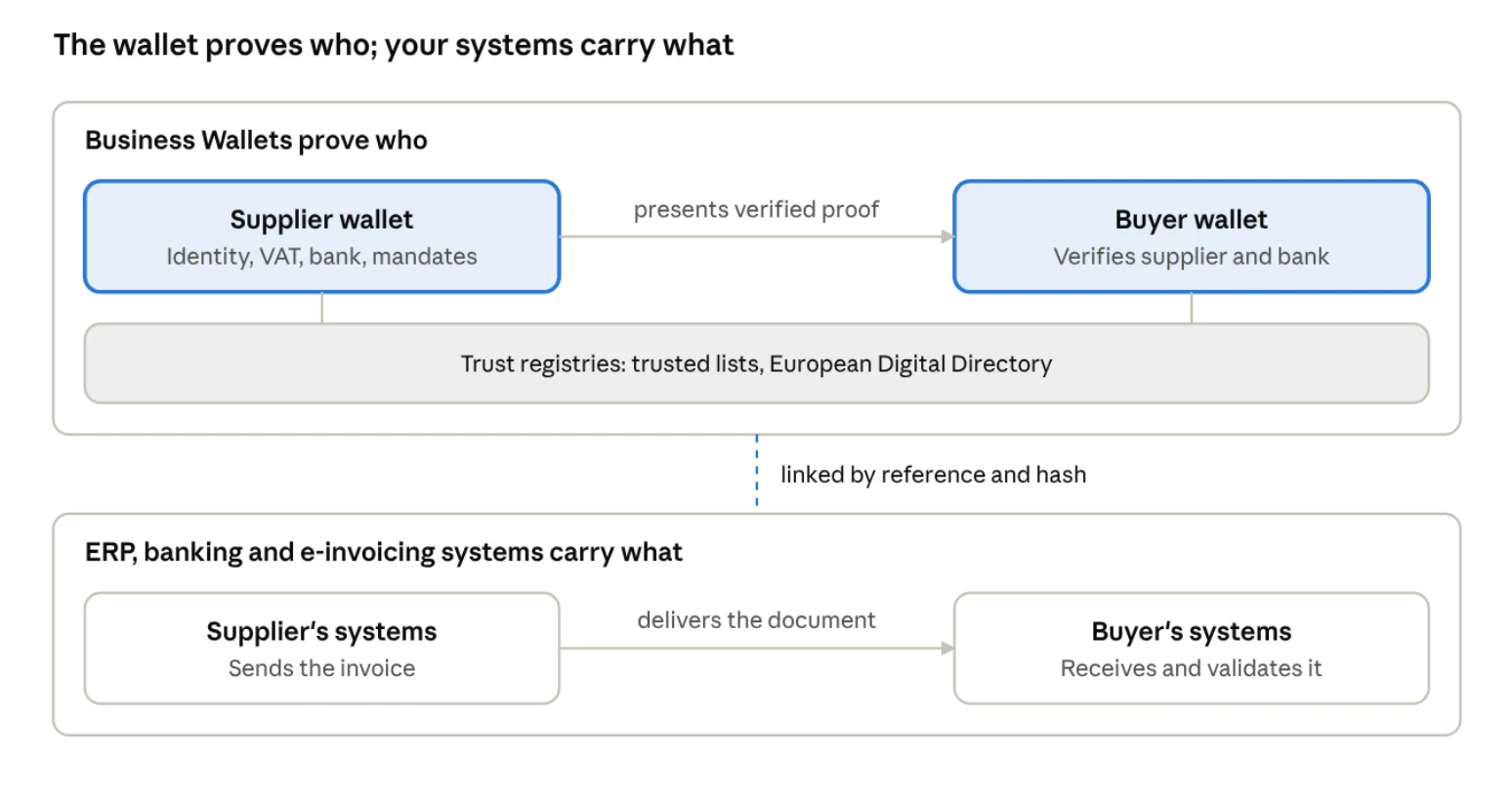
Two layers: wallets prove the parties, networks deliver the documents.
The document still travels through the systems you already use; the wallets make both ends verifiable, and the two meet through a reference and hash.
ERPs, procurement platforms, banks and e-invoicing services already move documents and money efficiently. What none of them can do alone is prove that a supplier is genuine, that a bank account belongs to it, or that the person who approved a deal was allowed to.
- Documents stay where they are authoritative. Pilots showed that putting whole business documents inside attestations breaks versioning, non-repudiation and sector rules. The wallet carries a reference and a hash; the system of record keeps the document.
- Onboarding becomes portable. A supplier proves its identity, VAT status and bank details once, from the source, and reuses that proof with every bank, buyer and platform.
- Approvals become verifiable. A mandate attestation shows who may approve or sign, checkable without a phone call.
- Connectors bring it into daily work. The wallet plugs into ERP, accounting and expense systems, so verified data lands in the tools people already use.
For most companies, an EBW will feel less like a new system and more like a trust layer added to the ones they have, delivered through their software vendor, bank or service provider.
See also: Transforming customer onboarding across regulated industries with EUDI Wallets, covering KYC, KYB and legally valid contract signing.
Use case: eReceipts, from purchase to VAT without retyping
An eReceipt is a signed, verifiable receipt issued by the seller straight into the buyer’s European Business Wallet. It completes the picture next to the e-invoice: the invoice covers what a company is billed, the eReceipt covers what its people buy on its behalf.
The EWC Large Scale Pilot first showed consumers paying with an EUDI Wallet and receiving an e-receipt. The WE BUILD Large Scale Pilot extends that to companies, end to end:
- The company is registered once. The seller’s business wallet checks the buyer’s organisation ID and VAT ID, and the employee’s identity from their EUDI Wallet, then issues the employee a corporate authenticator. No shared logins.
- The employee pays. From a company account or card, confirmed in the EUDI Wallet with strong customer authentication.
- The receipt arrives as a credential. The seller issues the eReceipt into the company’s European Business Wallet. Buyer and seller hold the same signed record, with VAT per rate and the payment reference.
- Accounting and tax close the loop. A connector books the receipt as an expense. The tax authority, a role Skatteverket would play in Sweden, verifies each receipt against trusted lists and reconciles reclaimable VAT, with nobody typing a line.
The mandate question is answered too: the corporate authenticator shows who was allowed to buy for the company.
- Watch the 60-second pitch or the full demonstration, from company registration to VAT reconciliation.
- Read the deep dive: Trusted eReceipts for B2B Payments: Taking EUDI Wallet Payments from the Consumer to the Company.
- Try it live: buy at the WE BUILD Shop, follow the receipt into the Bygg AB Business Wallet and see it verified at the National Tax Service demo.
Why it scales: verify once, reuse everywhere
The EBW changes what trust costs grow with: from the number of business relationships to the number of businesses.
- Today: every buyer, bank and marketplace re-verifies every supplier separately. A supplier with 50 customers is checked 50 times.
- With European Business Wallets: the supplier is verified once, at issuance, by the authoritative source. Every later check is a cryptographic verification against shared trust infrastructure.
Trust is not free. Verifiers still check trusted lists, revocation status and the legitimacy of the wallet itself. But that infrastructure is shared and largely cacheable, so the marginal cost of each check is low. The real cost moves to issuance and governance, where it is paid once rather than per relationship.
The same rails also carry far more than identity: mandates, signatures, licences, certificates, official notifications and digital receipts. New use cases do not need a new network.
Timeline and the interim period
eIDAS 2 applies now; the Business Wallet Regulation is still being negotiated, so early adopters build on today’s trust services and plan the migration.
- 19 November 2025: the Commission publishes the Business Wallet proposal, COM(2025) 838.
- 11 March to 6 May 2026: public feedback period on the proposal.
- September 2025 to September 2027: the WE BUILD Large Scale Pilot, around 200 organisations in 28 countries, builds on the EWC Large Scale Pilot of 2023 to 2025, testing the design in code and publishing its decisions openly.
- 24 months after entry into force: public sector bodies must accept European Business Wallets. The entry-into-force date depends on the legislative process.
- 1 July 2030: ViDA makes structured e-invoicing and digital reporting mandatory for intra-EU B2B transactions, raising the stakes on correctly identified trading parties.
The practical consequence: identity, mandates and evidence built on existing qualified trust services today can carry over into the European Business Wallet framework, if the migration path is designed in from the start.
Follow the pilot: iGrant.io’s WE BUILD deliverables, including eReceipts, account-to-account payments and conformance work.
Where it started: iGrant.io’s EWC pilot results and deployments and the EWC specifications for payments, receipts and trust.
What to do now
Start with one use case where verification already costs you money, and design for the interim period.
- Pick a wedge. Supplier onboarding, bank account verification or approval mandates are where pain and spend are highest today.
- Map your sources of truth. Which registers, tax authorities and banks would issue the attestations you rely on?
- Keep documents where they are. Plan for the wallet to prove the parties and reference documents, not to carry them.
- Design for automation with the owner in control. Explicit policies, always visible, always revocable.
- Follow the pilots. The WE BUILD architecture decisions, conformance specifications and attestation rulebooks are published openly.
Further reading
From iGrant.io
- Trusted eReceipts for B2B Payments
- Executive summary: European Business Wallet Regulation (2025)
- Business Wallets: Enabling Trust and Scale in the EUDI Wallet Ecosystem
- Transforming customer onboarding across regulated industries with EUDI Wallets
- iGrant.io in the WE BUILD Consortium
- Videos on the iGrant.io YouTube channel
From the pilots and the EU
- WE BUILD WP4 architecture blueprint
- Proposal status and consultation, Digital Policy Alert
- ViDA implementation timeline, Revenue Ireland
Want to see a European Business Wallet in action? Explore the Organisation Wallet Suite or book a demo.