WE BUILD Consortium convenes to align EUDI Wallet and European Business Wallet building blocks
iGrant.io co-leads Track 5 on Business Wallet Unit Attestation, lifecycle, binding, discovery and security
Description
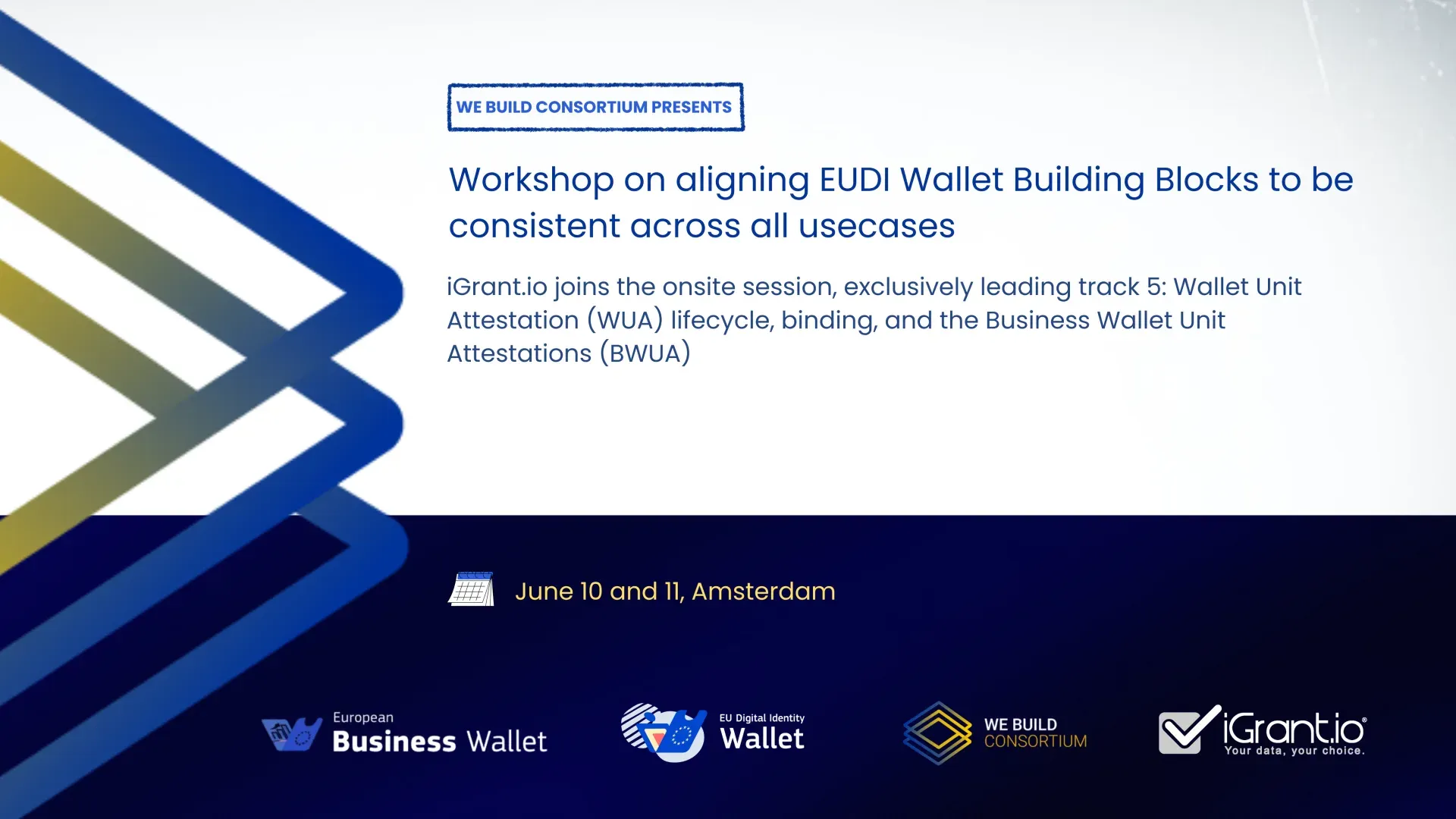
iGrant.io joins the WE BUILD Consortium operational workshop to advance consistent, reusable core models for European Business Wallet and EUDI Wallet implementations.
Event Details
Session: Operational work session on aligning a set of models to be consistent across all use cases
Date: 10 – 11 June 2026
Location: Amsterdam
Description
The WE BUILD Consortium is a large-scale European collaboration bringing together more than 200 organisations from 30 countries to develop and test the EU Digital Identity Wallet and European Business Wallet across business, supply chain, and payments use cases.
As the EUDI Wallet ecosystem moves from pilots towards implementation, one of the most important challenges is consistency. Wallet providers, issuers, verifiers, business registers, public authorities, QTSPs, and relying parties need shared models that work across use cases, sectors, and borders. On 10 and 11 June 2026, the WE BUILD Consortium holds an operational work session in Amsterdam to align a set of models that must remain consistent across all use cases.
Highlights of the session
The workshop is designed to move beyond individual use case discussions and focus on reusable building blocks that can support implementation across WP2, WP3, and WP4. The aim is to define practical decisions that can be implemented within the next six months and reused across WE BUILD scenarios.
Participants work in parallel tracks, each addressing a cross-cutting topic. The expected outcome is a set of clear, reusable decisions, shared definitions, and open issues that help reduce fragmentation and support interoperability across the European Business Wallet and EUDI Wallet ecosystem.
Session agenda
The workshop opens on 10 June with a plenary framing and alignment session, where participants confirm the core objective: producing decisions that others in the consortium can reuse. This is followed by track setup and the first working session, where each group defines the problem, begins documenting decisions, and pressure-tests conclusions across multiple use cases.
On 11 June, the working groups finalise their outputs and present key decisions, trade-offs, and open issues during the plenary readout. The session closes with a consolidation discussion to identify overlaps, dependencies, friction points, and next steps for continuing the work.
Scenario implementation tracks:
- Track 1: Identity Matching and Identifier Resolution
- Track 2: Trust Infrastructure and Intermediaries
- Track 3: Protocols, Automation and Machine-to-Machine Interaction
- Track 4: Mandates and Legal Representation
- Track 5: Business Wallet Unit Attestation, Lifecycle, Discovery and Security
iGrant.io’s role in the session
iGrant.io participates in the WE BUILD Consortium as part of the ongoing work to support the implementation of the interoperable European Business Wallet and the EUDI Wallet. Lal Chandran represents iGrant.io in the operational workshop and co-leads Track 5 on Business Wallet Unit Attestation, lifecycle, binding, discovery, and security.
This track is especially relevant to the practical implementation of European Business Wallets. Before a credential is issued, an issuer must be able to trust the wallet it is communicating with. This includes knowing whether the wallet is genuine, whether its keys are protected, and whether the credential is being delivered to the correct wallet instance.
Key outcomes expected from Track 5 include freezing the Wallet Unit Attestation lifecycle model for the natural-person wallet, starting the Business Wallet Unit Attestation model, and documenting open questions around binding, revocation granularity, dual-wallet flows, and business wallet discovery.
Why this matters
The EUDI Wallet ecosystem is moving from design and pilot phases into operational readiness. At this stage, interoperability depends not only on technical standards but also on shared decisions about identity matching, trust, mandates, protocols, wallet lifecycle, and security.
For business wallet use cases, these questions are even more critical. A European Business Wallet must support trusted interactions between companies, public authorities, banks, QTSPs, intermediaries, and relying parties. Without aligned models, each use case risks developing its own interpretation, creating fragmentation and slowing down adoption. At iGrant.io, we see this alignment work as an essential step in making digital identity infrastructure usable in real-world business transactions, where trust, security, interoperability, and accountability must work together.
About iGrant.io
Headquartered in Stockholm, Sweden, iGrant.io is at the forefront of the European digital identity landscape, providing production-ready infrastructure for secure, transparent, and verifiable data exchange across sectors such as healthcare, finance, business, and digital identity.
Learn more about iGrant.io’s Organisation Wallet Suite and Data Wallet capabilities, or contact us to explore how your organisation can get started with trusted digital identity and business wallet implementation.
Further Resources
- WE BUILD Consortium in Paris for advancing business transactions
- Deep dive on Wallet Unit Attestation
- EU Business Wallet, our offering: Organisation Wallet Suite
- iGrant.io Developer Docs