Trusted eReceipts for B2B Payments: Taking EUDI Wallet Payments from the Consumer to the Company
In the EWC Large-Scale Pilots we showed that a person can link a bank account to an EUDI Wallet and pay a merchant with strong customer authentication. The WE BUILD Large Scale Pilot picks up where that work stopped: the buyer is now a company, the payment runs on an account or a card, the seller issues a verifiable eReceipt straight into the buyer's European Business Wallet, and VAT is reconciled with the tax authority without anyone typing a receipt. This article shares what we built with the WE BUILD consortium and what we learned.
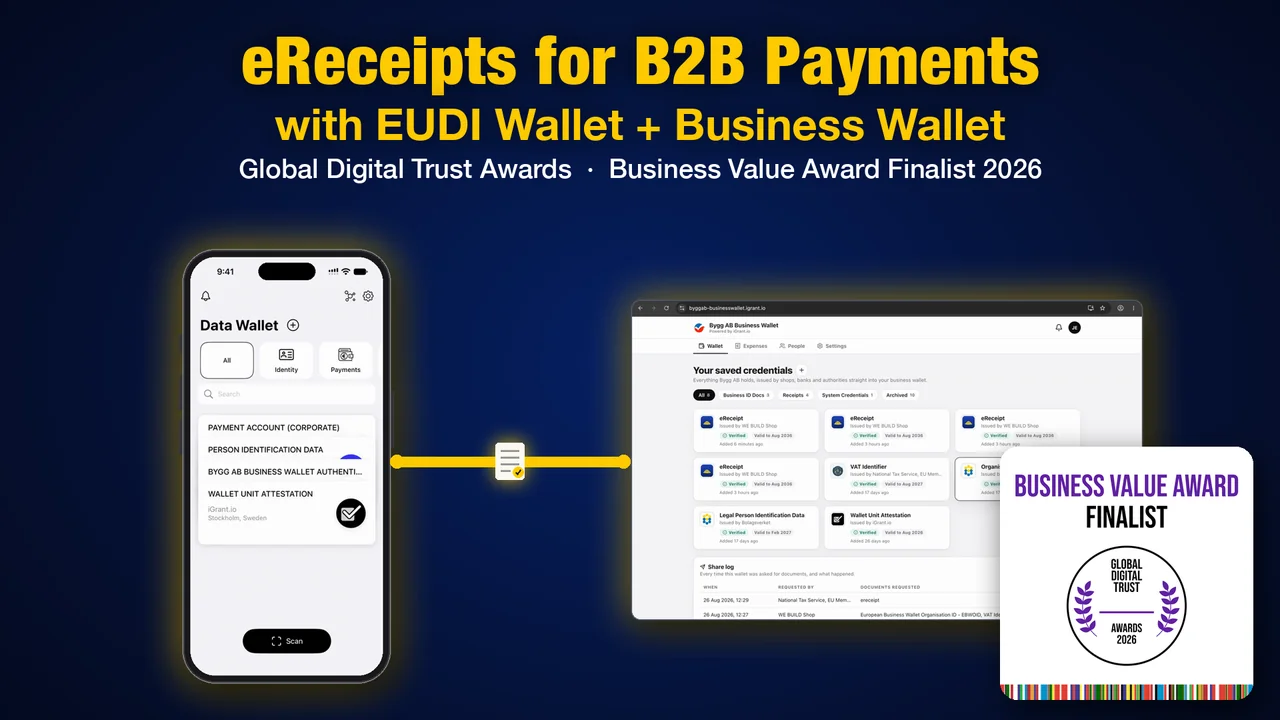
This article continues the story we told in Business Wallets: Enabling Trust and Scale in the European Digital Identity (EUDI) Wallet Ecosystem. That piece, based on the EU Digital Wallet Consortium (EWC) Large-Scale Pilots, argued that a wallet is only as useful as the ecosystem around it, and showed banks and merchants acting as issuers and verifiers in live payment flows. Since then, iGrant.io has carried the same building blocks into WE BUILD, the second-round EU Large Scale Pilot for business and payment use cases, launched in September 2025 with more than 200 organisations from 28 countries working on 13 use cases across business, supply chain and payments.
The use case we describe here is deliberately ordinary. A small construction company buys tools from an online shop. An employee pays. The company wants the receipt in its books and the VAT back. Today, that means a paper or PDF receipt, someone typing it into an accounting system, and a VAT claim that fails if the receipt is lost. The pilot replaces the whole chain with two wallets that work together: the employee’s EUDI Wallet and the company’s European Business Wallet.
The 60-second pitch: Trusted eReceipts for B2B payments
Where EWC left off: Consumer payments, card-based
Between 2023 and 2025, the EWC pilots established the payment pattern for the EUDI Wallet in three steps, each of which is now an EWC specification:
-
Linking a bank account to the wallet. The bank verifies the person identification data (PID) against the EU trust list and issues a Payment Wallet Attestation to the wallet (EWC RFC-007). See How to link EUDI Wallets to bank accounts and the step-by-step guide to issuing the payment authenticator.
-
Paying with strong customer authentication (SCA). The merchant presents the payment data, the wallet shows it to the payer and signs the confirmation, and the bank authorises the transaction (EWC RFC-008). See Merchant-led payments with the EUDI Wallet and the step-by-step guide to confirming payments.
-
Receiving a receipt in the wallet. After the payment, the merchant issues an e-receipt and, in the travel scenario, a boarding pass to the payer’s wallet (EWC RFC-011). See Prove ID, apply discounts, pay, and get the boarding pass and e-receipt in seconds.
EWC: Merchant-led payments with the EUDI Wallet and SCA
That work had two deliberate limits. The payer was a consumer, and the payment instrument was a card: the Payment Wallet Attestation represented a card, and the receipt went to the person who paid. Both limits are exactly what a company needs lifted.
What changes when the buyer is a company
When an employee pays for the company, the bank still authenticates a person. Accounting, however, needs the company: the receipt belongs to the legal entity, the legal entity reclaims the VAT, and the bookkeeping happens in the entity’s systems. A personal wallet holds a PID. A company needs a wallet that holds organisational credentials and can be operated by several people under delegated authority. This is why the pilot uses two wallets rather than stretching one, and why the European Commission’s proposal for a Regulation on European Business Wallets matters as much for payments as for company registration.
In the pilot, the buyer’s business wallet holds three credentials before the first purchase:
- the organisation identifier (the EU Business Wallet Organisation ID, EBWOID, previously called the Legal Person Identification Data, LPID), issued by the business register. Bolagsverket and iGrant.io demonstrated this issuance in the EWC pilot: EU Business Owner ID issuance to Business Wallets;
- the VAT identifier, issued by the national tax service;
- the wallet unit attestation, issued by the wallet provider.
Delegation is handled with credentials too. To register the company at the shop, the seller’s business wallet requests the organisation identifier and the VAT identifier from the company’s wallet and the PID from the employee’s EUDI Wallet. Once the company is registered, the shop issues a corporate authenticator to the employee’s EUDI Wallet. From then on, the employee signs in as a business user of that company by presenting the authenticator: no password, no shared login, and a clear record of who acted for whom. The pattern is the same one we used for onboarding in the EUDI Wallet Launchpad 2025 demonstration, now applied to purchasing.
Card and account: Two ways to pay through one SCA flow
The second limit to lift was the payment instrument. Much business spend in Europe moves account to account rather than by card, so a B2B flow that only understands cards would leave most invoices outside the wallet. In WE BUILD, the bank issues two payment credentials to the employee’s wallet: a payment account credential carrying the IBAN, BIC and currency, and a payment card credential carrying the last four digits of the PAN and the scheme. Both are selectively disclosable, so the payee learns only what it needs to route the payment.
At checkout, the shop’s business wallet sends an OpenID4VP request that carries the transaction data: amount, currency and payee. The employee chooses account or card, the wallet signs the transaction data together with the chosen credential, and the bank settles. From the merchant’s side, the two instruments look the same: one request, one signed response, one settlement callback. From the bank’s side, SCA is satisfied by the wallet’s signature over the exact transaction the payer saw. This directly extends RFC-008 from a consumer card to a corporate account.
The eReceipt is a credential, and both sides hold it
Once the bank confirms the payment, the seller’s business wallet issues the eReceipt as a verifiable credential (SD-JWT VC) over OpenID4VCI. It arrives in the buyer’s business wallet as a credential offer, is accepted by the employee, and the seller keeps the issued copy. Buyer and seller now hold the same signed document.
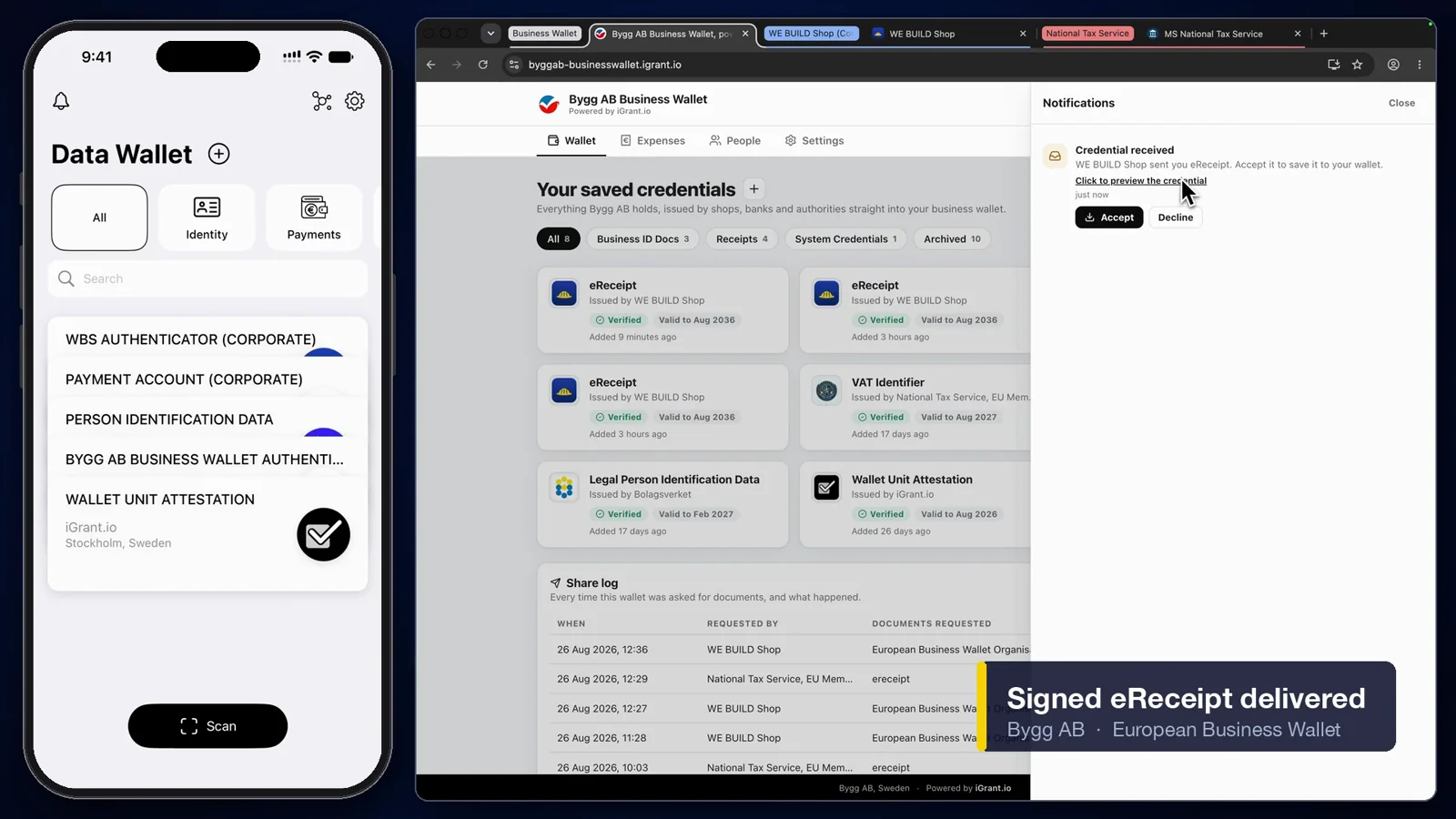
The receipt carries what accounting needs: the seller’s identity and VAT number, the line items, the totals excluding and including VAT, the tax subtotal per rate, and the payment reference. Because the seller signs it and is on a trust list, anyone with access to that list can verify it without calling the seller: the buyer, the buyer’s accountant, and the tax authority. This is the mechanism the previous article described under EWC RFC-012 and ETSI TS 119 612 trust lists, now applied to a document that changes hands between two organisations. The 60-second pitch shows the whole flow; the full demonstration walks through every screen.
Full demonstration: From company registration to VAT reconciliation (5:18)
From receipt to VAT: Closing the loop with accounting and the tax authority
A receipt in a wallet is only useful if it reaches the systems that run the company. The business wallet therefore has connectors. In the pilot, the ReceiptHero connector books each eReceipt as an expense in the company’s accounting, and the same connector model applies to banks and expense-management providers.
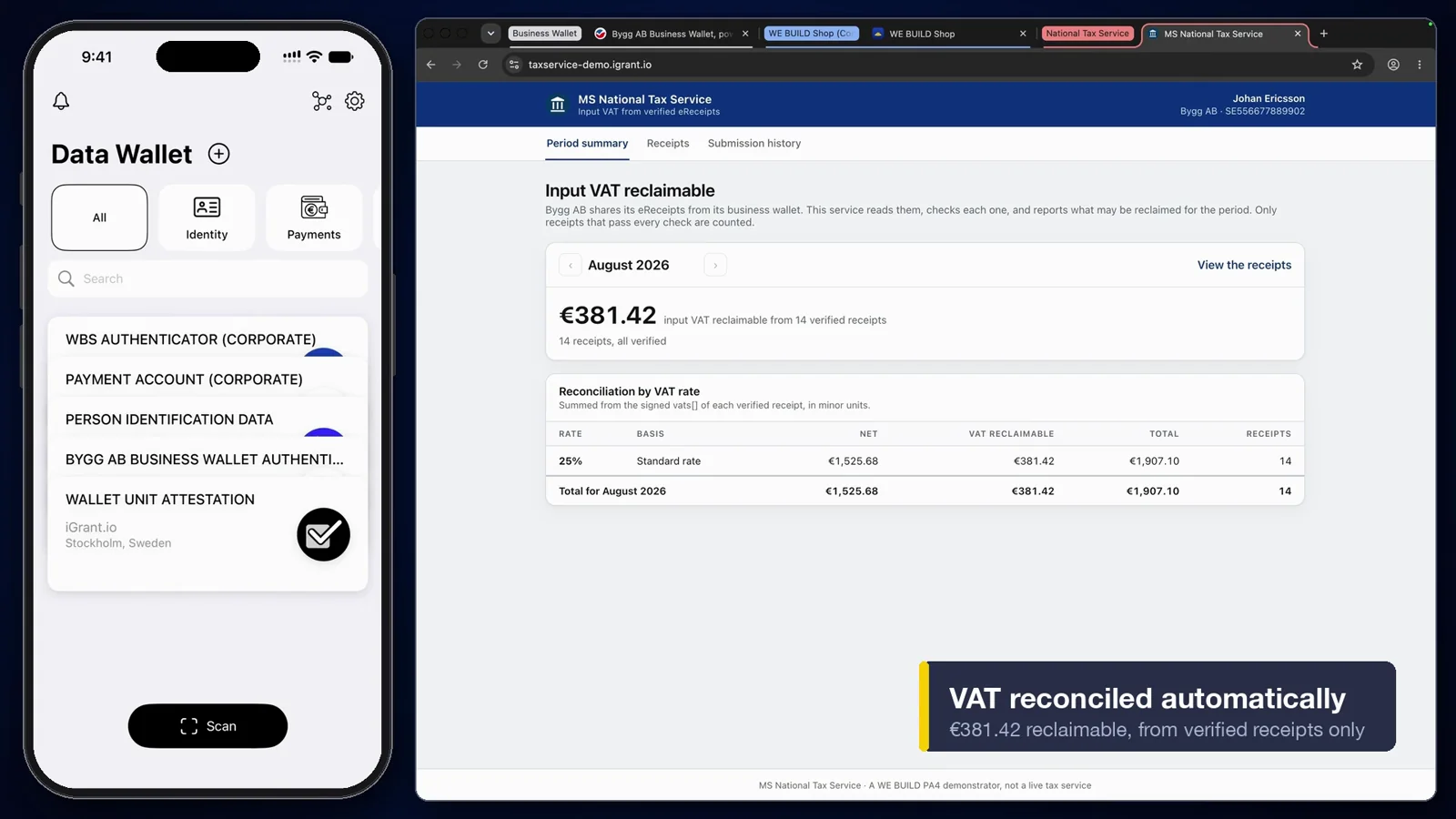
The last step is the one small companies care about most. From the Expenses and Tax screen, one click shares the month’s verified receipts with the National Tax Service. The tax service’s portal verifies each receipt on its own: signature validity, issuer trust and revocation status. It then reconciles the input VAT reclaimable for the period from verified receipts only. In the demonstration, it is EUR 381.42 from fourteen receipts, computed without anyone typing a line.
What we learned
- Two wallets, one flow. Do not push organisational credentials into personal wallets. Give the person an EUDI Wallet, give the company a European Business Wallet, and make them work together. Every attempt to merge the two reintroduced the mismatch between who pays and who owns the receipt.
- Delegation is the hard part, and credentials solve it. The corporate authenticator issued by the shop to the employee’s wallet replaced shared logins and manual role management. It also gives the seller a verifiable answer to the question “who was allowed to buy on behalf of this company”.
- B2B needs account-based payments. Extending the SCA flow from a card credential to an account credential was a small technical step with a large reach. The same OpenID4VP transaction-data pattern carries both.
- A receipt worth signing is a receipt worth verifying. Trust lists let the tax authority verify receipts without any integration with the seller. That is what makes automatic VAT reconciliation possible at all.
- Connectors make wallets useful. The accounting connector turned a wallet feature into a bookkeeping outcome. Without it the eReceipt is just a nicer PDF.
- Integration cost decides adoption. The shop and the SME integrated without writing code against wallet protocols; the business wallet exposes the flows as configuration. For companies with five employees, that is the difference between piloting and using.
- The value is measurable. Hours of manual entry disappear, VAT claims stop depending on a paper trail, and the same flow scales across Member States because every credential in it is issued under eIDAS 2.0 (Regulation (EU) 2024/1183).
Watch the videos
The WE BUILD use case and the EWC payment work it builds on, in order:
The 60-second pitch: Trusted eReceipts for B2B payments
Full demonstration: From company registration to VAT reconciliation (5:18)
EWC: How to link EUDI Wallets to bank accounts
EWC: Step-by-step guide to issuing the payment authenticator (part 1)
EWC: Step-by-step guide to confirming payments (part 2)
EWC: Merchant-led payments with the EUDI Wallet and SCA
EWC: Prove ID, apply discounts, pay, and get the boarding pass and e-receipt
EWC: EU Business Owner ID (EBWOID, LPID) issuance to Business Wallets
EUDI Wallet Launchpad 2025: Onboarding with the Business Wallet
Who built it and where to try it
The use case was built by a group of WE BUILD partners spanning banking, public administration, industry, receipt and accounting platforms, wallet providers and research:
- WE BUILD Consortium
- Onepoint (France)
- Valtiokonttori, the Finnish State Treasury (Finland)
- Bosch (Germany)
- OP Bank (Finland)
- University of the Aegean (Greece)
- Procivis (Switzerland)
- ReceiptHero (Finland)
- iGrant.io (Sweden)
*Note: Please alert if we missed anyone”
Everything shown here is live. Buy something with your phone and follow the eReceipt into the business wallet:
- WE BUILD Shop (seller)
- Bygg AB Business Wallet (buyer)
- PiggyBank (the buyer’s bank, which issues the account and card credentials)
- National Tax Service demo (receipt verification and VAT reconciliation)
The use case, “Trusted eReceipts for B2B Payments: issuing verifiable receipts to a European Business Wallet after EUDI-based SCA”, is a finalist in the Business Value Award category of the Global Digital Trust Awards 2026, with the winners announced at the Global Digital Collaboration conference in Geneva on 3 September 2026.
Call to action: Close the loop
The consumer side of EUDI Wallet payments is specified and piloted. The company side now is too. What remains is for each actor to take its part:
- Banks can issue payment account and payment card credentials to the wallets of their customers, and accept wallet-signed transaction data as SCA.
- Merchants and marketplaces can issue eReceipts from a business wallet as verifiable credentials, to consumers and to companies alike.
- Accounting and expense providers can connect to business wallets and receive receipts that are already verified.
- Tax authorities can accept verified receipts and reconcile VAT from them, as the pilot’s National Tax Service demonstrates.
If you are building any of these, we would like to work with you. Contact us at [email protected].
EUDI Wallet adoption depends on individuals downloading apps and on a trusted, standards-based business ecosystem around them. Payments and receipts are where the two meet, and the WE BUILD pilot shows that the meeting point works end to end.